
Extending MIDAS#
MIDAS ships with built-in support for RNA, ADT, and ATAC. If you want to extend the model — add a new modality, swap a transformation, plug in a new output distribution — this page walks you through the framework and the extension points.
Framework overview#
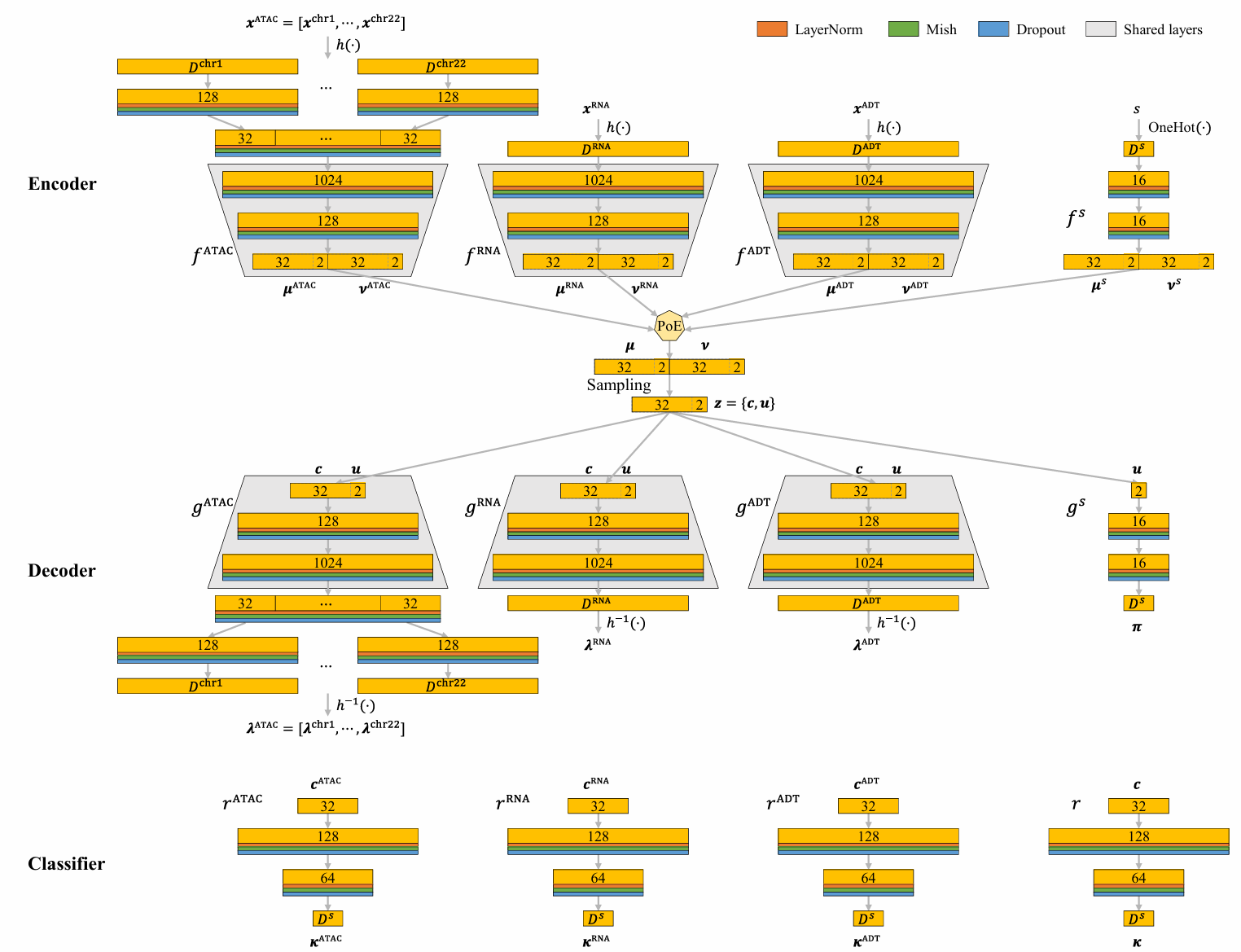
MIDAS is configured via scmidas.load_config() and is built on
multi-layer perceptrons (MLPs). The model has five components:
Components#
Data encoder — encodes each modality into a Gaussian latent (mean and log-variance).
Data decoder — reconstructs each modality’s counts from the joint latent.
Batch ID encoder — encodes batch indices into a Gaussian latent.
Batch ID decoder — reconstructs batch indices from the joint latent.
Discriminator — classifiers operating on modality-specific and joint latents (only the biological part
cis fed to the discriminator).
Note
MIDAS currently uses MLP-based encoders/decoders. Other architectures (CNN, transformer) are not built in but can be plugged in with custom modifications.
Network architecture:
Transformations and distributions#
MIDAS comes with a small registry of input transformations and output distributions. Both registries are extensible for new modalities.
Transformations#
A transformation is a pair (forward, inverse) applied around the
encoder/decoder so the model sees a numerically convenient
representation while still reconstructing the original counts.
Built-in pairs:
binarize
Forward:
x > 0(cast to binary).Inverse: identity.
Default for ATAC.
log1p
Forward:
log(x + 1).Inverse:
exp(x) - 1.Default for RNA and ADT (via
trsf_before_enc_rna/trsf_before_enc_adtin the configs).
Note
Two places consume transformation names:
transform=argument toscmidas.MIDAS— applied per minibatch in__getitem__and not inverted on the output side (used e.g. for ATAC binarization).configs['trsf_before_enc_<mod>']— applied inside the encoder forward pass; the inverse is applied after the decoder, so the loss is computed in the original count space.
Distributions#
A distribution registry entry bundles three pieces:
Loss function — the reconstruction loss.
Sampling — how to sample from the decoder’s output parameters.
Activation — the activation applied to the decoder’s final layer.
Built-in distributions:
POISSON — Poisson NLL loss; Poisson sampling; no output activation. Default for RNA and ADT counts.
BERNOULLI — binary cross-entropy loss; Bernoulli sampling; sigmoid output. Default for ATAC.
Default configurations#
The defaults below are loaded by scmidas.load_config(). Override any
key by mutating the dict before passing it to scmidas.MIDAS:
from scmidas.config import load_config
configs = load_config()
configs['lam_dsc'] = 30          # tweak a single hyperparameter
model = scmidas.MIDAS(mdata, configs=configs)
Embeddings#
Key |
Value |
Description |
|---|---|---|
dim_c |
32 |
Latent dimension for biological information c. |
dim_u |
2 |
Latent dimension for technical information u (always be small to avoid capturing biological information). |
Basic Network Structure (MLP)#
Key |
Value |
Description |
|---|---|---|
norm |
‘ln’ |
Use layer normalization. ‘bn’, ‘ln’, or False. |
drop |
0.2 |
Dropout rate. |
out_trans |
‘mish’ |
Activation function for the output. Support: ‘tanh’, ‘relu’, ‘silu’, ‘mish’, ‘sigmoid’, ‘softmax’, ‘log_softmax’. |
RNA#
Key |
Value |
Description |
|---|---|---|
trsf_before_enc_rna |
‘log1p’ |
Apply log1p transformation before encoding. Exponential transformation will be applied after decoding. |
distribution_dec_rna |
‘POISSON’ |
Poisson distribution assumption for decoder. |
ADT#
Key |
Value |
Description |
|---|---|---|
trsf_before_enc_adt |
‘log1p’ |
Apply log1p transformation before encoding. Exponential transformation will be applied after decoding. |
distribution_dec_adt |
‘POISSON’ |
Poisson distribution assumption for decoder. |
ATAC#
Key |
Value |
Description |
|---|---|---|
dims_before_enc_atac |
[128, 32] |
Independent MLP structure before shared encoder. It is used to compress the data chunks of the ATAC modality. |
dims_after_dec_atac |
[32, 128] |
Independent MLP structure after shared decoder. It expands the embeddings to reconstruct the ATAC modality. |
distribution_dec_atac |
‘BERNOULLI’ |
Bernoulli distribution assumption for decoder. Use BCE loss. |
Batch ID#
Key |
Value |
Description |
|---|---|---|
s_drop_rate |
0.1 |
Rate to drop batch Ids during training. |
dims_enc_s |
[16, 16] |
Encoder structure. |
dims_dec_s |
[16, 16] |
Decoder structure. |
dims_dsc |
[128, 64] |
Structure of the discriminator. |
Training#
Key |
Value |
Description |
|---|---|---|
optim_net |
‘AdamW’ |
Optimizer for the main network. |
lr_net |
1e-4 |
Learning rate for the main network. |
optim_dsc |
‘AdamW’ |
Optimizer for the discriminator. |
lr_dsc |
1e-4 |
Learning rate for the discriminator. |
grad_clip |
-1 |
Gradient clipping ( |
Loss Weights#
Key |
Value |
Description |
|---|---|---|
lam_kld_c |
1 |
Weight for variable c’s KLD loss. |
lam_kld_u |
5 |
Weight for variable u’s KLD loss. |
lam_kld |
1 |
Weight for total KLD loss. |
lam_recon |
1 |
Weight for reconstruction loss. |
lam_dsc |
30 |
Weight for discriminator loss (for training the discriminator). |
lam_adv |
1 |
Weight for adversarial loss. loss = VAE_loss - disc_loss * lam_adv |
lam_alignment |
50 |
Weight for modality alignment loss. |
lam_recon_rna |
1 |
Weight for RNA reconstruction loss. |
lam_recon_adt |
1 |
Weight for ADT reconstruction loss. |
lam_recon_atac |
1 |
Weight for ATAC reconstruction loss. |
lam_recon_s |
1000 |
Weight for batch IDs reconstruction loss. |
Discriminator Training#
Key |
Value |
Description |
|---|---|---|
n_iter_disc |
3 |
Number of discriminator training iterations before training the VAE. |
Data Loader#
Key |
Value |
Description |
|---|---|---|
num_workers |
20 |
Number of worker threads for data loading. |
pin_memory |
true |
Load data into pinned memory. |
persistent_workers |
true |
Persistent worker threads. |
n_max |
10000 |
Maximum number of samples per batch. |
Adding a new modality#
Adding a modality means telling MIDAS how to encode it, how to decode it, and how to score its reconstruction. The work is mostly configuration; you only write code if your modality needs a transformation or output distribution that isn’t in the registry yet.
Step 1 — declare the modality in the configs#
Load the defaults, set the per-modality keys, and pass the dict to
scmidas.MIDAS:
import scmidas
from scmidas.config import load_config

configs = load_config()

# Optional: a forward/inverse transformation pair applied around the
# encoder/decoder. Must already be in transform_registry (see Step 2).
configs['trsf_before_enc_<mod>'] = 'log1p'

# Optional: per-chunk encoder dimensions, e.g. when splitting by
# chromosome (as ATAC does).
configs['dims_before_enc_<mod>'] = [512, 128]
configs['dims_after_dec_<mod>']  = [128, 512]

# Required: output distribution. Must already be in
# distribution_registry (see Step 2).
configs['distribution_dec_<mod>'] = 'POISSON'

# Optional: reconstruction-loss weight (default 1).
configs['lam_recon_<mod>'] = 1
Then provide your data on the MuData and pass dims_x to
scmidas.MIDAS.setup_mudata() if the modality is split into chunks:
scmidas.MIDAS.setup_mudata(
    mdata,
    batch_key='batch',
    dims_x={'<mod>': [512, 512, 256]},   # only needed for chunked modalities
)
model = scmidas.MIDAS(mdata, configs=configs)
If the transformation or distribution name doesn’t exist in the registry the constructor raises an error — register it first (Step 2).
Step 2 — register a new transformation or distribution (if needed)#
Both registries live in scmidas.nn.
Transformation:
from scmidas.nn import transform_registry

def asinh5(x):
    import torch
    return torch.asinh(x / 5)

def asinh5_inv(x):
    import torch
    return 5 * torch.sinh(x)

transform_registry.register('asinh5', asinh5, asinh5_inv)
Distribution:
from scmidas.nn import distribution_registry

def my_loss(pred, target):
    ...
def my_sampler(params):
    ...
def my_activation(x):
    ...

distribution_registry.register('my_dist', my_loss, my_sampler, my_activation)
Once registered, the names are usable from configs exactly like the
built-in 'log1p' / 'POISSON' / 'BERNOULLI'.
Contributing#
Bug reports and feature requests are welcome via
GitHub issues. For code
contributions, branch from main, make sure pytest tests/ passes,
and open a pull request — for non-trivial changes, please open an issue
first to discuss the design.